ACL Tear Treatment in Colorado: Your Guide to Recovery and Return to Playing Sports
An ACL tear is one of the most common and frustrating knee injuries for athletes and active individuals. Whether you twisted your knee on the field or felt a sudden pop during a workout, knowing your treatment options and recovery path is key to getting back to what you love.
At the Orthopaedic & Spine Center of the Rockies (OCR), our fellowship-trained surgeons and sports medicine specialists offer ACL tear treatment tailored to your activity level, goals, and long-term knee health.
What Is an ACL Tear?
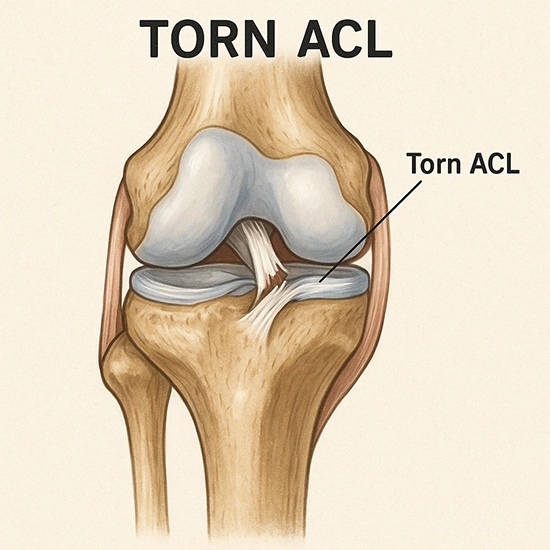
The anterior cruciate ligament (ACL) is one of the four main ligaments in the knee joint. It connects the thighbone (femur) to the shinbone (tibia) and helps stabilize the knee, particularly during activities involving pivoting, sudden stops, or changes in direction.
An ACL tear occurs when the ligament is overstretched or torn, either partially or completely. This often happens during sports that involve cutting or jumping movements. Tears are graded by severity and are usually diagnosed through a combination of a physical exam, patient history, and imaging such as an MRI.
Signs of an ACL tear include:
- A popping sound or sensation at the time of injury
- Rapid swelling within 24 hours
- Knee instability or a “giving way” feeling
- Pain during twisting or pivoting movements
Does an ACL Tear Always Require Surgery?
No. Not all ACL injuries require reconstruction. Many patients do very well without surgery, depending on their specific situation. The right path depends on several factors, and there is no one-size-fits-all answer.
Who Is a Candidate for Non-Surgical Treatment?
Non-surgical ACL treatment is often appropriate for patients who meet one or more of the following:
- Partial tears with good knee stability — if the remaining ligament tissue is intact and the knee functions well, surgery may not be needed
- Lower activity level or recreational goals — patients who do not participate in cutting or pivoting sports can often return to their activities without surgical reconstruction
- Older age combined with lower physical demands — the risk-benefit calculation shifts for patients who are not planning to return to high-demand athletics
- Children with open growth plates — in younger patients, surgery timing requires careful consideration to protect developing bone; Dr. Ryan Hartman, MD, our pediatric orthopaedic and sports medicine specialist, evaluates these cases individually
Conservative treatment at OCR includes customized physical therapy, bracing for knee support, and activity modification guidance. Our PM&R (Physical Medicine & Rehabilitation) specialists can also help manage pain, optimize function, and guide a conservative recovery.
When Is ACL Reconstruction the Right Choice?
Surgical reconstruction is generally the better option when one or more of the following apply:
- Return to cutting or pivoting sports — soccer, basketball, skiing, lacrosse, and similar sports place high rotational demands on the knee that a non-surgically treated ACL may not handle reliably
- Significant knee instability — if the knee gives way during everyday activities, reconstruction restores stability more reliably than conservative care alone
- Complete tears in younger, active patients — full-thickness tears in athletes who want to return to sport have consistently better outcomes with reconstruction
- Associated injuries — if the ACL tear is accompanied by meniscus damage or other ligament injuries, surgical treatment is often necessary to address everything at once
- Failed conservative treatment — if physical therapy and bracing have not restored adequate stability, reconstruction becomes the recommended next step
ACL reconstruction is highly successful for restoring knee stability and is performed using a tendon graft to replace the torn ligament. At OCR, our ACL surgeries are performed by fellowship-trained orthopaedic surgeons using minimally invasive techniques, with in-house physical therapy and follow-up care throughout recovery.
ACL Recovery: What to Expect
Whether your treatment is surgical or non-surgical, structured rehabilitation is the foundation of a good outcome.
Your OCR care team will monitor your progress closely throughout rehabilitation, conducting regular evaluations to assess strength, movement patterns, knee stability, and function before clearing you for high-risk activities.
OCR supports patients through:
- Personalized therapy sessions
- Sports-specific rehab protocols
- Return-to-play testing to reduce re-injury risk
How Long Does ACL Recovery Take?
Recovery timelines vary based on whether you had surgery, your sport, and how your body responds to rehabilitation. General guidelines:
- Non-surgical recovery: Many patients return to low-demand activities within 3 to 6 months with consistent physical therapy
- Post-surgical recovery: Most patients are walking well by 6 weeks, returning to non-cutting activities around 3 to 4 months, and cleared for full sport between 9 and 12 months
- Re-injury risk: Research from the Mayo Clinic indicates that up to one-third of athletes sustain another ACL tear within two years of returning to sport. Extending the rehabilitation timeline and passing return-to-sport testing significantly reduces that risk
Our sports medicine physicians use evidence-based return-to-sport testing and individualized timelines. There is no universal date. What matters is that your knee is ready.
Meet OCR’s ACL and Knee Specialists
OCR offers both surgical and non-surgical ACL care through a team of fellowship-trained surgeons and board-certified sports medicine physicians. Our surgical knee specialists include Dr. Rocci Trumper, MD, who has presented research on ACL surgery outcomes, as well as Dr. Nirav Shah, MD, Dr. Joshua Snyder, MD, and Dr. Matthew A. Javernick, MD, all fellowship-trained in sports medicine and knee disorders.
For non-surgical evaluation and conservative management, OCR’s sports medicine team includes Dr. Brian Lancaster, MD, Dr. Thomas Anderson, DO, Dr. Jeffrey Ebel, DO, Dr. Rick Morgan, MD, Dr. Niki Vischer, MD, Dr. Domonic Torri, DO, Dr. Peter Wood, MD, Dr. Tammy Ng, MD, Dr. Curtis Leonard, MD, and Dr. Vincent “Skip” Ross, MD. For younger athletes, Dr. Ryan Hartman, MD provides pediatric orthopaedic and sports medicine care.
Why Choose OCR for ACL Tear Treatment in Colorado?
As the trusted orthopaedic care provider for Colorado State University, the Colorado Eagles, and dozens of regional high schools, the Orthopaedic & Spine Center of the Rockies brings elite-level care to patients of all ages and activity levels. Our advantages include:
- Board-certified, fellowship-trained knee surgeons
- On-site imaging, surgery centers, and physical therapy under one roof
- Both surgical and non-surgical options, with treatment plans built around your goals
- Locations across northern Colorado including Fort Collins, Loveland, Greeley, Longmont, Lafayette, and Westminster
Whether you are navigating a first-time injury, deciding between surgical and non-surgical care, or considering revision surgery, OCR is here to help you make the right call for your body and your goals.
Take the Next Step
If you are dealing with knee pain or instability after an ACL injury, do not wait. Early evaluation opens up more treatment options and leads to better outcomes.
Request an appointment with a knee specialist at OCR to start your personalized treatment plan.